
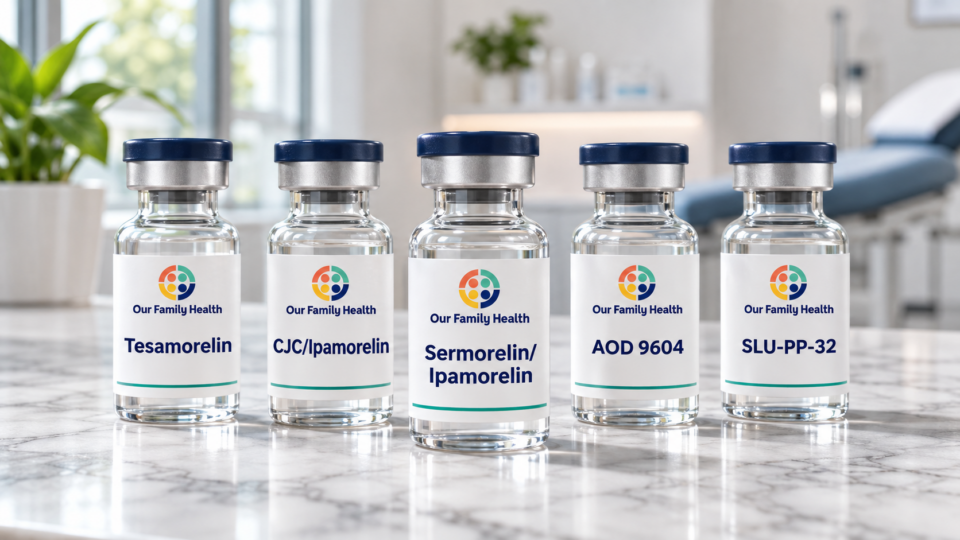
What Peptides Are and How They Work
Peptide therapy in Monroe, Georgia, is attracting growing interest from people exploring medically supervised options for weight management, recovery, energy, and healthy aging. For those searching for peptide therapy Monroe GA, it’s important to understand both the established uses and the investigational status of these treatments. Peptides have become a major topic in conversations about weight management, recovery, energy, healthy aging, and overall wellness. Some peptide medications are well established and FDA-approved for specific medical conditions. Others remain investigational, with limited evidence about their safety and effectiveness.
That distinction matters.
If you are considering peptide therapy in Monroe, Georgia, understanding what peptides are—and what medical supervision should involve—is an important first step.
What Are Peptides?
Peptides are short chains of amino acids, the same basic building blocks that form proteins. Although proteins are generally larger and more complex, peptides contain fewer amino acids and often act as signaling molecules.
Your body naturally produces many peptides. They help regulate processes such as:
- Hormone signaling
- Metabolism and blood sugar regulation
- Digestion and appetite
- Immune function
- Tissue growth and repair
- Reproductive health
- Communication between cells
Some familiar medications are peptide-based. For example, semaglutide and tirzepatide act on peptide hormone pathways involved in appetite, digestion, and blood sugar control. Other peptide products promoted for recovery, longevity, energy, or cognitive performance have much less clinical evidence and may not be FDA-approved.
In other words, “peptide” describes a broad type of molecule—not one specific treatment.
How Does Peptide Therapy Work?
Peptides interact with receptors on or inside certain cells. You can think of a peptide as a messenger carrying instructions to a particular destination. When it reaches a compatible receptor, it may influence a biological process such as hormone release, appetite signaling, or glucose regulation.
The effect depends entirely on the peptide. Different peptide medications have different targets, uses, risks, and levels of supporting research.
A peptide does not automatically become safe simply because it resembles something naturally produced by the body. Insulin, for example, is a naturally occurring peptide hormone, but using too much can be dangerous. The dose, formulation, method of administration, medical condition being treated, and quality of the product all matter.
What Is Peptide Therapy Used For?
FDA-approved peptide medications are used for several recognized medical purposes, including diabetes, obesity, osteoporosis, certain hormone disorders, and other specific conditions.
Other peptides are being studied or promoted for goals such as:
- Supporting weight management and metabolic health
- Improving body composition
- Supporting exercise recovery
- Influencing growth hormone pathways
- Addressing certain sexual-health concerns
- Supporting healthy aging
- Improving energy, sleep, or focus
The evidence for these uses varies considerably. Some applications are supported by large clinical trials and FDA-approved medications. Others are based primarily on laboratory studies, animal research, small human studies, or anecdotal experience.
A knowledgeable medical provider should explain which category a proposed therapy falls into, what evidence supports it, and what uncertainties remain.
Are Peptides FDA-Approved?
Some are, and some are not.
Several peptide medications have received FDA approval for clearly defined uses. Semaglutide, tirzepatide, insulin, glucagon, tesamorelin, and teriparatide are examples of peptide-based or peptide-related medications with approved indications.
Many products marketed online as “wellness peptides,” however, are not FDA-approved. Some have not been evaluated in adequate human clinical trials. The FDA has specifically identified limited safety information and potential quality concerns for a number of substances, including BPC-157, CJC-1295, ipamorelin, MOTS-c, and others.
“Not FDA-approved” does not always mean that a substance has been proven dangerous. It does mean the FDA has not verified that product’s safety, effectiveness, dosage, or manufacturing quality for a proposed use.
Patients deserve to know that difference before making a treatment decision.
What About Compounded Peptides?
Compounding can meet an important medical need when an FDA-approved medication is unavailable or unsuitable for an individual patient. A licensed compounding pharmacy may prepare a customized strength, dosage form, or formulation when clinically appropriate.
However, compounded medications are not FDA-approved. The FDA does not review each compounded product for safety, effectiveness, or quality before it reaches patients.
Poor-quality compounding may lead to contamination, incorrect potency, sterility problems, or peptide-related impurities. These risks are especially concerning with injectable products.
When a compounded medication is being considered, ask:
- Why is a compounded product appropriate for me?
- Is an FDA-approved option available?
- Which licensed pharmacy will prepare it?
- What quality and sterility standards does the pharmacy follow?
- How should the medication be stored and administered?
- What side effects or warning signs should I watch for?
- How will my response be monitored?
Avoid products labeled “for research use only,” substances purchased from unverified websites, or injectable peptides obtained without a legitimate prescription and medical evaluation.
Why Medical Supervision Matters
Effective peptide care involves much more than choosing a product based on an online symptom list.
Before recommending treatment, a provider should review your symptoms, medical history, prescriptions, supplements, health goals, and risk factors. Depending on the treatment, baseline laboratory testing may also be appropriate.
Medical oversight may include:
- Confirming that your symptoms are properly evaluated
- Screening for contraindications and medication interactions
- Selecting an evidence-based treatment when one is available
- Establishing a clear dose and administration plan
- Teaching safe storage and injection technique
- Monitoring side effects
- Repeating relevant laboratory tests
- Evaluating whether the treatment is producing a meaningful benefit
- Discontinuing treatment when the risks outweigh the results
Peptide therapy should complement an appropriate medical evaluation—not delay the diagnosis of fatigue, unexplained weight changes, persistent pain, sleep problems, hormonal symptoms, or other health concerns.
Do Peptides Need to Be Cycled?
There is no universal cycling schedule that applies to every peptide.
Some treatments are intended for long-term use, while others may be prescribed for a limited period or reassessed at specific intervals. Recommendations depend on the medication, indication, available evidence, response to treatment, and potential effect on the body’s normal signaling pathways.
Taking breaks simply because a product is called a peptide is not an evidence-based rule. Your provider should give you a treatment schedule specific to the medication and explain why that schedule is appropriate.
Never change the dose, extend treatment, or restart a peptide without medical guidance.
Who Should Avoid Peptide Therapy?
Whether peptide therapy is appropriate depends on the specific product and the individual patient. Extra caution—or avoidance—may be necessary for people who:
- Are pregnant, trying to become pregnant, or breastfeeding
- Have active cancer or a history of certain cancers
- Have significant liver, kidney, endocrine, or cardiovascular disease
- Take medications that could interact with the proposed treatment
- Have had an allergic reaction to an ingredient
- Participate in drug-tested athletic competition
- Have an unexplained symptom that still requires diagnostic evaluation
A history of cancer is not governed by one universal rule for every peptide. Decisions should be individualized and may require input from the patient’s oncologist.
Competitive athletes should also review the current World Anti-Doping Agency rules. Certain peptide hormones, growth factors, releasing factors, and related substances are prohibited in and out of competition.
What Results Can You Expect?
Results vary according to the therapy, the condition being addressed, and the individual. Peptides are not a shortcut around nutrition, movement, sleep, stress management, or treatment of an underlying medical condition.
Before beginning therapy, you and your provider should define:
- The goal of treatment
- How improvement will be measured
- When the treatment will be reassessed
- What side effects require a call or visit
- When therapy should be stopped
Be cautious of anyone promising rapid healing, guaranteed fat loss, disease reversal, or dramatic “anti-aging” effects. Responsible medical care should give you realistic expectations and acknowledge where the science remains uncertain.
Questions to Ask a Peptide Therapy Provider
Before starting treatment, consider asking:
- Is this peptide FDA-approved for my condition?
- If its use is off-label or investigational, what evidence supports it?
- Are there FDA-approved alternatives?
- What are the known and unknown risks?
- Where will the medication come from?
- What laboratory testing or follow-up will I need?
- How will we determine whether it is working?
- What is the plan if I experience side effects?
- How long should treatment continue?
- What will the full cost of treatment and monitoring be?
A trustworthy provider should welcome these questions.
Personalized Peptide Therapy in Monroe, Georgia
At Our Family Health Wellness Center, peptide therapy begins with an individualized medical assessment. Our licensed providers consider your health history, symptoms, medications, laboratory results, and personal goals before discussing whether a peptide-based treatment may be appropriate.
When compounded medications are used, we source them through our U.S.-based licensed compounding pharmacies rather than unregulated or research-grade sellers. Treatment plans may include baseline testing, follow-up appointments, and ongoing monitoring based on the medication and your individual needs.
Our Wellness Center is located at 211 Baker Street in Monroe, GA, making medically supervised wellness services accessible to patients in Monroe and surrounding Walton County communities.
Is Peptide Therapy Right for You?
Peptide-based treatments can be valuable in the right clinical setting, but “peptide therapy” is not one uniform treatment. Some peptide medications are supported by substantial clinical evidence, while others remain experimental.
The safest place to begin is with a medical evaluation—not an online peptide seller.
If you would like to explore peptide therapy in Monroe, GA, contact Our Family Health Wellness Center at 678-998-1515 or request more information through our website. A licensed provider can help you understand the potential benefits, limitations, alternatives, and risks based on your individual health needs.
This article is intended for general educational purposes and is not a substitute for personalized medical advice, diagnosis, or treatment. Peptide therapy services are subject to provider evaluation, clinical appropriateness, applicable law, and product availability.